At its Build 2026 developer conference in San Francisco, Microsoft didn't just show off a new feature here and there — it laid out a vision where autonomous AI agents are woven into nearly everything: the apps you use at work, the operating system underneath them, and even the physical hardware you'll eventually carry around. CEO Satya Nadella used the keynote to argue that "agentic AI" is moving from demo-ware to enterprise infrastructure, and the company backed that up with a long list of new tools, models, and devices.
"Autopilots": Microsoft's pitch for enterprise-grade agents
The headline theme of the keynote was what Nadella calls Autopilots - his term for AI agents built to handle real work autonomously rather than just answering questions. The clearest example is Scout, a new Copilot agent that quietly works through your inbox and messages, flags the things that actually need a decision from you, and surfaces them so you're not digging through a flooded inbox to find what matters.
Microsoft leaned hard on the idea that this isn't a novelty. The company pointed to its own 2025 Work Trend Index, which found that 81% of business leaders expect AI agents to be moderately or extensively built into their company's AI strategy within the next year or so. Whether or not that number plays out, it's clearly the bet Microsoft is making with this entire event.
Advertisement
Microsoft IQ and Work IQ: giving agents context
An agent is only as useful as the information it can see, and that's where Microsoft IQ and Work IQ come in. Think of them as a shared context layer that plugs into GitHub Copilot, Microsoft Foundry, and Copilot Studio, giving agents access to the things they'd need to actually be helpful - your emails, your meetings, your project history in Microsoft 365 - instead of operating in a vacuum. Work IQ specifically is what lets an agent understand "what you're working on" well enough to act on it. Microsoft says general availability lands on June 16, 2026.
Keeping agents on a leash: Windows security controls
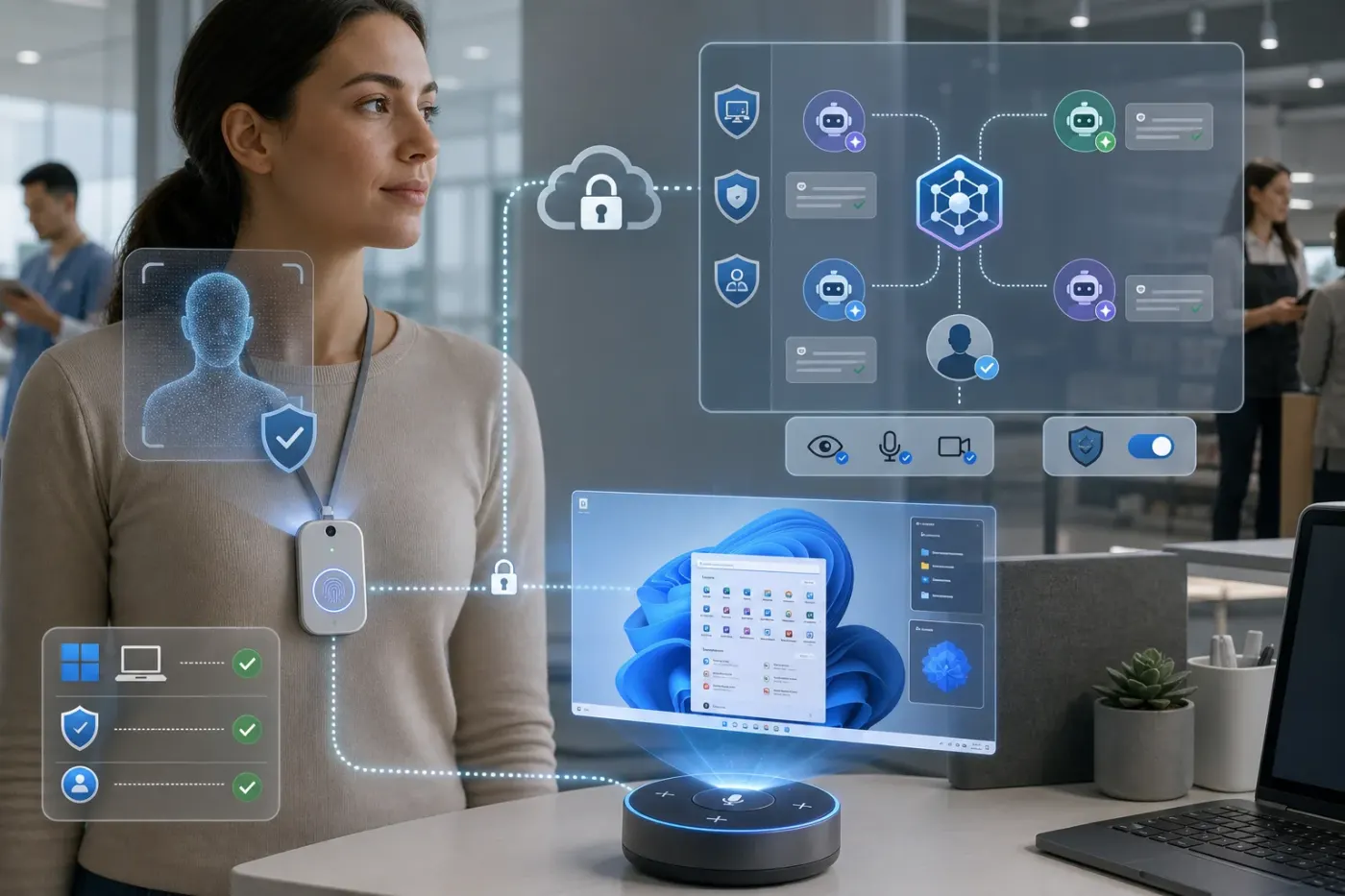
Letting an AI agent looser on your computer raises an obvious question: what stops it from doing something destructive? Microsoft's answer is Microsoft Execution Containers (MXC) - a way of running AI agents inside restricted sandboxes on Windows so they can't reach beyond what they're supposed to touch. In a live demo, Microsoft showed an agent being unable to delete files from the desktop even after its other safety layers had been deliberately switched off, which was clearly meant to reassure IT departments nervous about handing agents real permissions.
Peter Steinberger, creator of the agent framework OpenClaw, joined the conversation to make a related point: enterprises don't want an "all or nothing" choice between locking an agent out completely or giving it the keys to everything. His framework is moving toward granular, configurable permissions so companies can decide exactly what an agent is allowed to see and do — a more realistic middle ground for serious deployments.
A whole family of in-house "MAI" models
Microsoft also used Build to put more weight behind its own models, branded under the MAI name and built by its in-house Microsoft AI unit - a notable move for a company so closely associated with OpenAI. The lineup includes:
- MAI Thinking-1 - Microsoft's first dedicated reasoning model, reportedly built on roughly 35 billion active parameters with a 256K-token context window. Microsoft claims it matches Anthropic's Claude Opus on coding benchmarks, and it's currently in private preview on Microsoft Foundry.
- MAI-Code-1 - a coding-focused model now available inside Copilot and VS Code.
- MAI-Transcribe-1.5 - a transcription model supporting 43 languages.
- MAI-Voice-2 - adds 15 new languages and voice options for speech generation.
- MAI-Image-2.5 - an image model rolling out in PowerPoint and Foundry now, with OneDrive support planned.
The MAI Thinking-1 comparison to Claude Opus is the one worth watching - it signals that Microsoft wants credible alternatives to the frontier models it currently licenses from partners, not just thin wrappers around someone else's API.
✦ Free Newsletter ✦
Never miss a story
Tools, tutorials and AI deep-dives - straight to your inbox, every week.
Advertisement
Project Solara: hardware built for agents from the ground up
Perhaps the most surprising announcement was Project Solara, a reference design platform for what Microsoft is calling "agent-first" hardware. Rather than retrofitting AI into existing device categories, Solara is meant to help partners build devices designed around having an agent as the primary interface - early prototypes shown included something the size of a smart speaker and an access badge that responds to fingerprint and voice input.
The hardware runs on chips from Qualcomm and MediaTek, sits on top of Microsoft's Android-based Device Ecosystem Platform, and - importantly - Microsoft says it won't sell these devices itself. Instead, it's positioning Solara purely as a reference design for partners to build on. Early pilot partners reportedly include AccuWeather, Best Buy, CVS Health, and Target, though no public launch date has been set.
A "dream machine" for AI developers
For developers who want serious local AI horsepower, Microsoft showed off the Surface RTX Spark Dev Box - a compact development machine built around Nvidia's RTX Spark chip that Microsoft says can run AI models with up to 120 billion parameters directly on the device, no cloud required. Nadella didn't hold back on the marketing language, calling it a "dream machine" for builders who want to iterate on large models without waiting on remote infrastructure.
Beyond the office: science and healthcare
Microsoft also used the keynote to highlight where its AI work is heading outside of typical productivity scenarios. Microsoft Discovery, an Azure-based platform for scientific research, is already being used by organizations like BHP for mining research, GSK for drug development, and Syensqo for semiconductor work - all areas where sifting through huge amounts of data and running simulations is the bottleneck.
On the healthcare side, Microsoft announced an expanded partnership with the Mayo Clinic to apply frontier AI models to medical diagnostics, pairing Microsoft's reasoning models and infrastructure with Mayo's clinical expertise. It's an early-stage collaboration, but it signals where Microsoft thinks some of the highest-stakes (and highest-value) applications of these models will land.
The bigger picture
Taken as a whole, Build 2026 reads less like a single product launch and more like a statement of direction: Microsoft wants AI agents to show up in your inbox, your IDE, your operating system, your office hardware, and eventually devices that don't look like computers at all. The MAI model family suggests the company also wants more control over the AI stack it's building all of this on top of, rather than depending entirely on outside partners.
Advertisement
Whether "Autopilots" become as central to daily computing as Nadella hopes will depend on the unglamorous stuff - reliability, security, and whether agents actually save people time rather than creating new things to supervise. But with sandboxed execution environments, a context layer for agents, an in-house model lineup, and even purpose-built hardware on the table, Microsoft has clearly decided this is the bet worth making.
Advertisement