
In March, Nvidia CEO Jensen Huang said something at a conference that, read back now, sounds less like ambition and more like an early warning siren nobody fully heard at the time. He said he would be "deeply alarmed" if a software engineer earning $500,000 a year wasn't spending $250,000 of that figure on AI tokens annually.
That was the mood across corporate AI for most of the past eighteen months. Spend more. Spend faster. Worry about the value later, because the value would obviously be there - it had to be, given how transformative everyone agreed the technology was. Companies built internal leaderboards ranking employees by how many AI tokens they burned through in a given week, treating raw consumption as a proxy for productivity, the same way a sales floor might rank reps by calls made rather than deals closed.
The term that emerged to describe this behaviour, half-joking and entirely accurate, was "tokenmaxxing" - maxing out AI usage for its own sake, with little or no scrutiny of whether the output actually justified the cost. Eighteen months later, the joke has stopped being funny inside finance departments, and a wave of companies - from ride-sharing giants to twenty-five person startups - are now pulling the emergency brake at almost exactly the same moment, in a pattern that has real consequences for how the entire AI industry's biggest players make their money.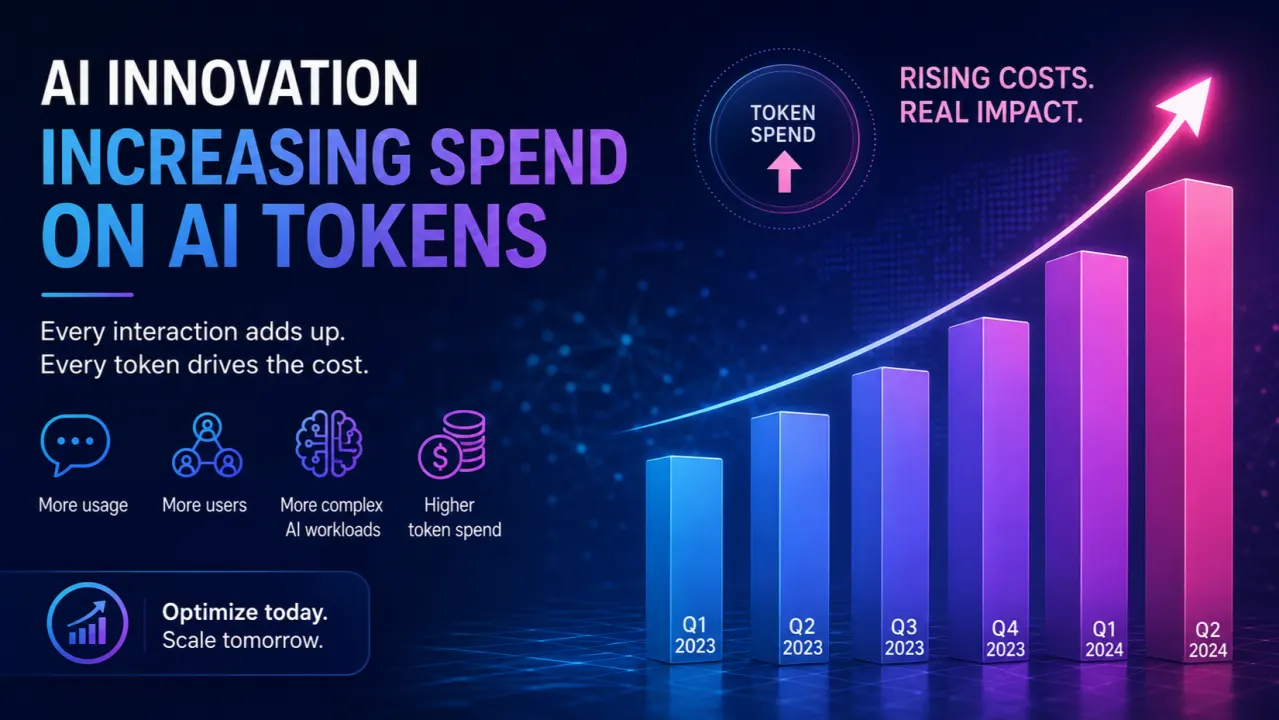
Advertisement
How Bad the Spending Actually Got
The specific numbers that have surfaced in recent reporting are worth sitting with, because in isolation any one of them sounds like an outlier. Together, they describe an industry-wide pattern.
Uber rolled out Anthropic's Claude Code to its engineering organisation in December 2025. Usage reportedly doubled within two months, as developers got hooked on its ability to handle complex, multi-step coding tasks with minimal supervision. Per-employee costs ran somewhere between $500 and $2,000 a month depending on how aggressively individual engineers used the tool. By April 2026 - just four months after the rollout began - Uber had exhausted its entire annual AI budget for the year. Uber's CTO, Praveen Neppalli Naga, confirmed the figure publicly, and the company's COO reportedly described the situation as one where internal AI costs had become "harder to justify."
Disney's situation, reported separately, involved engineers using Claude approximately 51,000 times per day across the organisation, at a volume significant enough that the company had to build a dedicated internal dashboard simply to track and manage token usage across its various AI tools. Visa, in a single month - March 2026 - burned through 1.9 trillion tokens, after the company had actively encouraged staff to "tokenmaxx" as part of its broader AI adoption push. Meta built an internal leaderboard of its own, ranking employees by token consumption, treating heavy usage as a visible signal of engagement with the technology - a leaderboard the company has since quietly shut down.
Microsoft CEO Satya Nadella, asked directly about the phenomenon during a live taping of The New York Times' Hard Fork podcast, did not dodge the question or distance the company from the behaviour. His answer was simply: "a lot." He went further, admitting the habit was personal - that he considered himself a tokenmaxxer too, and described it candidly as addictive. His point, delivered with the kind of frankness that rarely survives a corporate press office, was not that AI usage itself was the problem. It was that organisations had stopped matching the size of the tool to the size of the task - routinely deploying frontier-grade models, the most expensive and capable tier available, on requests that didn't remotely require that level of capability.
One consultant's account, reported by Axios, captured the absurdity at its most extreme: a client's employee was reportedly using their company's enterprise AI subscription to check the weather.
The Mechanism Behind the Madness
Understanding why this happened requires understanding what made tokenmaxxing feel rational, even smart, at the exact moment it was happening - because nobody involved thought they were being reckless at the time.
Token usage is, in a narrow technical sense, genuinely and precisely measurable in a way that almost nothing else about office productivity has ever been. You can count tokens exactly. You can chart them by employee, by team, by week. You can rank people by the number, the same way you might rank a sales team by calls dialled. That measurability made tokens an unusually seductive proxy for a much harder thing to actually quantify: whether AI adoption inside an organisation was working.
The trouble, as one analysis bluntly summarised it, is that token usage measures motion, not value. A team can burn through enormous volumes of tokens refactoring a genuinely important piece of legacy code, summarising thousands of customer support tickets into something useful, or generating real, actionable sales research. The exact same volume of tokens can also be consumed running a two-line email through a top-tier reasoning model that didn't need anywhere near that level of capability, or generating the same meeting summary three separate times "just in case," for a meeting whose notes nobody was ever actually going to read.
Multiply that ambiguity across an organisation with several thousand employees, each individually empowered and actively encouraged to use as much AI as they wanted, with no meaningful distinction drawn between high-value and low-value usage, and the costs were always going to compound in a way that very few finance departments had modelled accurately in advance. Jellyfish, an engineering analytics firm, found a data point that captures the gap precisely: heavy users of Claude Code were burning through roughly ten times more tokens than moderate users inside the same organisations, while their actual measured output increased by only about two times. The spending scaled far faster than the value did.
The Crackdown, Company by Company
The correction, once it started, has moved quickly and become remarkably consistent across very different types of organisation, which is itself a signal that this isn't an isolated cost-control story at one or two companies but a structural shift across the industry.
Advertisement
Uber's specific response, once the scale of the overrun became impossible to ignore internally, was to introduce monthly spending tiers on certain AI coding tools - including Claude Code and Cursor - starting at a base level of $1,500 per employee per month, with higher tiers available only on specific request and approval. Every employee can now see their own individual usage tracked on an internal dashboard, and exceeding the base cap requires explicit permission rather than happening by default.
Meta shut down its internal token-usage leaderboard entirely, after what amounts to an acknowledgment that ranking employees by raw consumption had been actively counterproductive - encouraging exactly the kind of low-value, high-volume usage pattern the Jellyfish data above illustrates. Microsoft, despite Nadella's own candid admission of being a tokenmaxxer himself, has been promoting Copilot's Auto Mode feature internally and to customers as the structural fix - a routing system that automatically sends simpler, lower-stakes tasks to smaller, cheaper models rather than defaulting every request to the most expensive frontier-grade option available, regardless of whether the task actually demands it.
The Wall Street Journal has reported that this pattern of rationing AI access - limiting who within an organisation gets access to the most expensive tools, and actively steering general usage toward cheaper alternatives - now extends well beyond Uber specifically, including Microsoft, Meta, and Salesforce among the companies actively tightening internal AI spending controls in 2026.
The Startup Version of the Same Story
The crackdown is not confined to large, well-resourced corporations with dedicated finance teams capable of absorbing a budget overrun and course-correcting calmly. It is hitting much smaller, much more financially exposed companies even harder, and arguably faster, because the consequences are existential rather than merely uncomfortable.
✦ Free Newsletter ✦
Never miss a story
Tools, tutorials and AI deep-dives - straight to your inbox, every week.
Flo Crivello, CEO of the roughly twenty-five person AI startup Lindy, described the situation to CNBC in terms that left little room for ambiguity. Earlier this month, Lindy moved 100% of its AI traffic away from Anthropic's Claude models entirely, switching instead to DeepSeek - the Chinese AI lab known specifically for offering considerably cheaper, open-weight model alternatives to the leading Western frontier labs. "We did it, and you could see that cost curve go down, like, crash to the ground," Crivello said. He estimated the switch would save the company millions of dollars within months - and despite that dramatic cut, Lindy still expects to spend more on AI in 2026 than on payroll for its entire team. Asked directly why he made the switch, Crivello did not frame it as an optimisation exercise or a routine vendor negotiation. "It's a matter of survival for the business," he said. "That's all it is."
DeepSeek's own pricing strategy has been a direct and explicit beneficiary of exactly this dynamic. The company recently announced a 75% discount on its primary model, and has separately been reported cutting API prices by as much as 90% in certain configurations - pricing moves clearly timed and positioned to capture exactly the wave of enterprises now actively searching for lower-cost alternatives to OpenAI and Anthropic's considerably more expensive frontier offerings. Nadav Maslej, an AI economics researcher quoted in the CBC's coverage of this same shift, offered a useful piece of broader context: "this is all evidence of a technology that's still in its very early days in terms of not only its capability, but also how it's priced." The implicit point being that prices this volatile, falling this fast, in either direction, are not the signature of a mature, settled market - they're the signature of one still actively discovering what it should actually cost.
Why This Genuinely Threatens OpenAI and Anthropic's Growth Story
This is the part of the story that moves beyond individual corporate cost-cutting anecdotes into something with real, structural significance for the entire AI industry - and it's worth being precise about exactly why.
OpenAI and Anthropic have been the two principal beneficiaries of the spend-without-much-scrutiny mentality that defined enterprise AI adoption through 2024 and into 2025, and that beneficial relationship has directly fuelled both companies' genuinely extraordinary growth rates. Both companies confidentially filed paperwork for what would be among the most closely watched IPOs in recent technology history in early June 2026. Gil Luria, an equity analyst at D.A. Davidson covering the sector, offered a pointed and specific read on the timing to CNBC: "current growth rates for Anthropic and OpenAI are the fastest they will ever be, which is mostly a matter of basic math." His direct implication: that basic mathematical reality - the fact that hypergrowth off a small initial base inevitably decelerates as the base gets larger - is itself "a good reason to go public now," compounded by a second, sharper concern, that "some of their largest enterprise customers may start limiting their out-of-control token spend."
That second part of his warning is no longer a hypothetical risk sitting somewhere in the future. It is precisely the dynamic that Uber, Lindy, Visa, and a growing list of other named companies are already actively living through, in real time, this quarter.
Advertisement
The competitive response from the rest of the industry has been swift and entirely predictable once you understand the underlying economics. Amazon's top AI executive, Peter DeSantis, told CNBC the company hopes to be able to compete more directly with OpenAI and Anthropic's frontier models within "the coming year," explicitly framing the company's strategy around cost: "AI has a cost problem," he said. "If we ultimately want AI to transform everything, the costs have to be different." Amazon intends to lean on its own in-house custom chips specifically to develop and serve models at meaningfully lower cost than its two largest rivals. Google, for its part, showcased Gemini 3.5 Flash prominently at its own developer conference - a deliberately lighter-weight model priced, according to CEO Sundar Pichai, at roughly half, and in some configurations closer to a third, of what comparable frontier-tier models from competitors typically cost.
Microsoft's Satya Nadella, in a separate June essay, articulated the underlying strategic anxiety driving this entire competitive response with unusual directness for a CEO of his stature: "The last thing any of us want is a world where every company across every sector is ceding value to a few models that eat everything they see," he wrote. "If all the value is accrued by only a few models, the political economy will simply not tolerate it."
What This Does Not Mean - And the Nuance Almost Everyone Is Missing
It would be a significant misreading of this moment to conclude that enterprise AI adoption is reversing, slowing meaningfully in aggregate, or that the underlying technology has somehow disappointed relative to expectations. The actual picture emerging from the reporting is considerably more precise and, frankly, more interesting than a simple narrative of retreat.
OpenAI's own disclosed data shows Codex - its agentic coding product - has grown more than five times since the start of 2026 alone, with customers including GitHub, Nextdoor, and Notion actively building genuine multi-agent systems capable of executing substantial pieces of real engineering work end to end with minimal human intervention. That is not a company in retreat. Two distinct stories are unfolding genuinely simultaneously, and they are not actually contradictory, even though they can superficially appear to be: rapid, continued enterprise adoption of AI capability on one side, and a sharp, deliberate, cost-driven pullback in undisciplined usage on the other.
What is actually happening is not that companies are abandoning AI. It is that they are becoming considerably more deliberate, more financially disciplined, and more genuinely results-oriented about precisely where and how they deploy it - retiring the leaderboard-driven, consumption-as-a-virtue mentality of the past eighteen months in favour of something closer to ordinary, mature, conventional enterprise software procurement, complete with budgets, usage caps, and tiered access based on actual demonstrated need rather than blanket permission to use the most expensive available tool for every task regardless of complexity.
The genuinely open and consequential question that OpenAI, Anthropic, and their increasingly well-funded and cost-competitive rivals now have to answer is whether they can simultaneously satisfy two pressures that, until recently, didn't appear to be in tension with one another at all: the continued ambition of genuine enterprise-wide AI transformation, and the financial discipline now being actively and explicitly demanded by CFOs, boards, and the COOs who, like Uber's, are no longer willing to describe unmonitored AI spending as anything other than what it actually was.
The Bigger Pattern This Reveals
Step back from the specific companies and the specific dollar figures, and what this moment actually represents is enterprise AI adoption completing the same maturity curve that essentially every previous significant wave of enterprise technology has gone through before it - just compressed into a dramatically shorter timeframe than any prior cycle managed.
Cloud computing went through an almost identical phase roughly a decade ago: an initial period of enthusiastic, under-scrutinised adoption, frequently summarised at the time as "lift and shift everything to the cloud," followed inevitably by a sharper, more disciplined cost-optimisation phase once the actual bills started arriving in finance departments at a scale nobody had fully modelled in advance. AI is moving through a recognisably similar arc - explosive, scrutiny-free adoption, followed by a cost reckoning - except compressed from the better part of a decade down into roughly eighteen months, which says something genuinely notable about both how quickly this specific technology demonstrated enough value to justify the initial enthusiasm, and how quickly its costs scaled large enough to force the correction that inevitably follows.
Advertisement
The market, per the analysts quoted throughout this reporting, is unlikely to simply reject frontier-tier AI capability outright as a category. What looks far more probable, based on the actual behaviour of the companies named above, is a more selective and considerably more mature market - one that increasingly reserves the most expensive, most capable frontier models specifically for the categories of task that genuinely justify their cost, while routing the much larger volume of routine, lower-stakes work toward the new generation of cheaper, lighter-weight alternatives that Amazon, Google, Microsoft, and DeepSeek are all now racing, with real urgency, to build and aggressively price.
Jensen Huang's vision of every well-compensated engineer spending half their salary on tokens annually may yet prove directionally correct over some longer time horizon. But the events of the past several weeks make one thing considerably clearer than it was even two months ago: getting there is going to run through boardrooms doing genuine cost-benefit arithmetic, not through leaderboards rewarding consumption for its own sake.
The free-spending era of corporate AI adoption did not end because the technology stopped working. It ended because, as it turns out, technology this expensive eventually has to answer to the same finance department that everything else in a company has always had to answer to - and the bill, after eighteen months on the house, has now genuinely come due.

Advertisement