
There's a line from the Coinbase CEO's announcement that stuck with me. Brian Armstrong didn't say the company was struggling. He didn't cite a market downturn, a missed earnings target, or a strategic pivot. He said Coinbase was going to rebuild itself to be "lean, fast, and AI-native" - and then showed 700 people the door.
Revenue wasn't the problem. The company was growing. AI just made the headcount feel unnecessary.
That's a different kind of layoff. And it's the kind that's been happening across the tech industry at a pace that deserves more attention than it's getting.
Advertisement
By the latest count from Layoffs.fyi, 93,294 tech workers have been let go so far in 2026. We'll cross 100,000 before the month is out. The first quarter alone saw 52,050 cuts - a 40% jump from the same period last year. March 2026 was the worst single month for tech layoffs since 2024.
The reason cited, over and over, in earnings calls and CEO blog posts and HR announcements: AI.
Not market conditions. Not rising interest rates. Not a pandemic hangover. AI.
The Honesty Is New - And That's What Makes It Different
Tech layoffs aren't new. The industry has been cutting since 2022, when the post-pandemic hiring boom that turned bloated engineering teams into budget line items finally reversed. Nearly a million technology jobs have been eliminated globally since 2021.
But something changed in 2026. The explanations changed.
For two years, the standard layoff announcement followed a predictable formula. Companies cited "macroeconomic headwinds," "strategic reprioritisation," "right-sizing for the current environment." AI was occasionally mentioned as a background factor but rarely as the main event. Nobody wanted to be the company that said out loud: we fired these people because a machine is cheaper.
That pretence has collapsed. The Freshworks CEO told Reuters directly that over half the company's code is now written by AI, that routine work has been automated, and that the headcount reduction followed naturally from that. Coinbase's Armstrong didn't soften it either. The "AI-native" framing was the point, not a footnote.
This is either an admirable moment of corporate honesty or a sign that the reputational risk of saying "AI took these jobs" has become lower than the reputational risk of pretending otherwise. Probably both.
Either way, it marks something. The abstract debate about whether AI would affect white-collar employment has ended. The answer is now visible in quarterly filings.
The Companies and the Numbers
The scale of what's happened in 2026 becomes clearer when you look at it company by company rather than as an aggregate.
Dell cut 11,000 jobs in the first quarter - the single largest reduction at any one company in the period, according to executive coaching firm Challenger, Gray and Christmas. Atlassian cut 1,600 positions, 10% of its global headcount, in March, explicitly citing AI investment as the reason. Autodesk shed around 1,000 employees in January. Workday trimmed 400 roles in February.
In the gaming sector, Epic Games cut more than 1,000 people - 20% of its entire team. Amazon announced 16,000 corporate employee cuts in January, with the company stating AI would handle the work instead. Oracle cut thousands while simultaneously taking on debt to fund AI investments - a move that captures the central paradox of the moment: the same technology being used to justify the layoffs is also the thing companies are borrowing billions to invest in.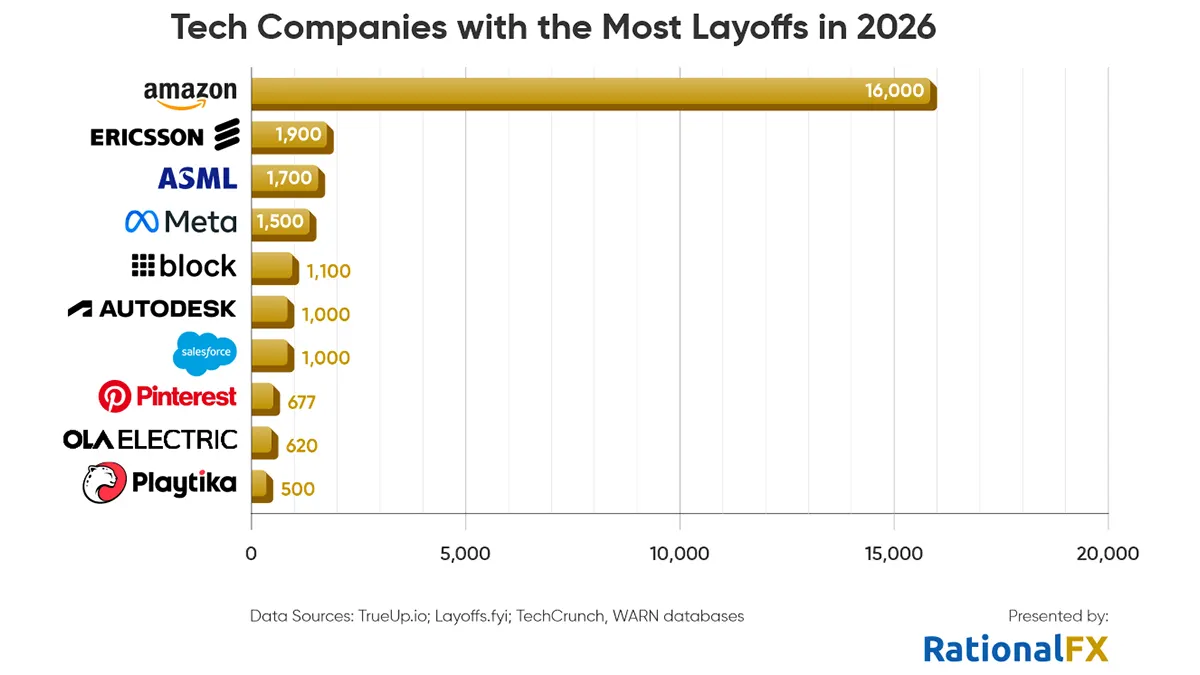
Advertisement
Meta's situation deserves its own sentence. In March, Mark Zuckerberg announced plans to reduce headcount by up to 20% - roughly 15,000 jobs - explicitly framing it as a way to fund AI investment. The company wasn't in crisis. It was profitable. The logic was: fewer humans, more AI spend, same or better output. Investors responded positively.
That's the part that should give everyone pause.
What Jobs Are Actually Going
The early narrative around AI and employment was reassuring in a specific way: the jobs at risk were routine, repetitive, easily automated. Data entry. Customer service scripts. Basic code generation. The implicit promise was that knowledge workers doing complex, creative, judgment-heavy work were safe.
That promise is looking shakier in 2026.
Layoffs are no longer concentrated at entry level or in support functions. Senior positions and specialised technical roles are being cut. Product managers - a role built around judgment, prioritisation, and communication between technical and business stakeholders - are showing up in layoff announcements. Mid-level engineers with years of experience. Customer success teams that required genuine domain knowledge to do well.
The Freshworks cut is particularly telling. The company grew revenue 16% while cutting 11% of its workforce. That's not a struggling company shedding weight. That's a healthy company deciding its existing workforce is larger than its AI-augmented operations require. Growing revenue, shrinking headcount. Those two things were not supposed to be able to happen simultaneously at this scale.
✦ Free Newsletter ✦
Never miss a story
Tools, tutorials and AI deep-dives - straight to your inbox, every week.
The emerging model has a name now: the "one-person pod." Small, tightly focused teams — sometimes individual employees - running workflows that previously required five to ten people, with AI handling the volume and a human providing direction, judgment, and quality control. The pod produces the output of a small team at the cost of one salary.
For companies, this is an obvious win. For the people who used to fill those pods, it is not.
The Honest Question Nobody Wants to Answer
Here's the thing that the corporate announcements don't address, and that most coverage skates past: where do those people go?
The standard response from economists and tech optimists is that automation historically creates more jobs than it destroys. The industrial revolution eliminated certain types of work and created entirely new categories of employment that nobody predicted. The same will happen with AI.
This argument is probably correct in the long run. It's also cold comfort on a specific Tuesday when your access badge stops working.
The more pressing version of the question is about the transition period. Historical technology transitions - from agricultural to industrial, from industrial to knowledge economy - took generations. The people displaced by one wave of automation were often not the people who benefited from the next wave. Their children were.
Advertisement
AI is moving faster than any previous technology transition. The gap between "this capability exists" and "this capability is deployed at scale in enterprise workflows" has compressed from decades to years to, in some cases, months. The mechanisms society has for managing workforce transitions - retraining programmes, social safety nets, gradual industry adjustment - were not designed for this pace.
That gap between the speed of AI deployment and the speed of social adaptation is where the real cost of the current layoff wave lives. Not in the aggregate statistics, but in the specific humans who spent years developing skills that a CEO just announced are no longer needed.
What the Companies Who Aren't Cutting Are Doing
It's worth noting, because the narrative can become totalising, that not every company is responding to AI by cutting headcount.
Some organisations are using AI productivity gains to expand output rather than reduce costs. Engineering teams that can move faster are shipping more, entering new markets, building things that weren't feasible at the old pace. In these companies, headcount is flat or growing - not because AI hasn't changed the work, but because the productivity gain is being invested in growth rather than extracted as cost reduction.
The difference tends to come down to what the company is optimising for. A mature company with a stable product and pressure to improve margins will cut. A growing company with opportunities it couldn't previously pursue will expand. Both are responding rationally to the same underlying technology.
This distinction matters for anyone trying to understand where the tech job market is actually healthy. It's not uniformly bleak - it's bifurcated. Infrastructure, AI tooling, applied ML engineering, security for AI systems, and roles requiring deep domain expertise combined with AI fluency are in genuine demand. The roles being cut are concentrated in the middle - the execution layer that AI is absorbing.
The Number That Tells the Whole Story
In March 2026, AI was listed as the cause for 25% of all tech layoffs. In February, that figure was 10%.
In a single month, AI's share of the stated reason for job cuts in the tech sector went from one in ten to one in four.
That's not a trend line. That's a threshold being crossed. Companies that were cautiously, quietly attributing cuts to AI in their internal conversations started saying it out loud in their filings. The social permission to be honest about it spread, apparently, quite quickly.
By the time you read this, the number will be higher. The companies that haven't made their announcements yet are watching Coinbase and Freshworks and noting that the market didn't punish them for the honesty. In some cases it rewarded them.
Advertisement
That's the dynamic that will keep the numbers climbing through the rest of 2026. Not malice. Not panic. Just companies following the incentives that have always driven corporate decisions, applied to a technology that happens to be faster and more capable than anything that came before it.
The 100,000 figure is a milestone. It's also, almost certainly, just the beginning of a much larger number.
The question of what comes after that number - for the people it represents, for the industry's talent pipeline, for the social contract between tech companies and the communities they operate in — is one the industry is not yet seriously engaging with.
It probably should be.
Advertisement