Andrej Karpathy posted a tweet in February 2025 that most people in mainstream tech missed. The former Tesla AI director and OpenAI founding member described a new way he was building software - not by writing code carefully and deliberately, but by describing what he wanted to AI tools and accepting whatever came out, barely reading the results. He called it vibe coding. "I just see stuff, say stuff, run stuff, and it mostly works," he wrote.
Eighteen months later, that throwaway description has become one of the most debated concepts in software development. The vibe coding tools market hit $4.7 billion in 2026, growing at 38% annually - already larger than the entire global market for traditional code editors and IDEs was in 2023. GitHub Copilot has passed 20 million users. Cursor, one of the newer AI-first code editors, reached a $2 billion valuation. Lovable, a tool that builds full applications from descriptions rather than code, raised at $400 million.
The adoption curve is real. The conversation about what it actually means is still catching up.
Advertisement
What Vibe Coding Actually Is - And What It Isn't
The term has become slightly slippery in the past year, so it is worth being precise.
At one end of the spectrum is AI-assisted coding - what most developers are already doing. GitHub Copilot autocompletes your code. Claude Code takes a task and implements it across multiple files. Cursor rewrites functions based on natural language instructions. You are still writing code, making architectural decisions, reviewing output, and maintaining control. The AI is a very fast, occasionally unreliable collaborator.
At the other end is what Karpathy was actually describing - pure vibe coding. You prompt. The AI generates. You run it. If it works, you move on without reading what was produced. If it doesn't, you describe the error back to the AI and prompt again. No manual code. No architecture decisions you consciously make. No code review in any traditional sense.
Most people talking about vibe coding in 2026 are doing something in between - heavier AI involvement than the Copilot-as-autocomplete model, lighter than the pure "I never read the code" approach. The distinction matters because the productivity gains, the quality risks, and the skills required are different at each point on that spectrum.
The number that captures where things actually stand: 41% of code written in 2026 is now AI-generated. That is not a projection. It is the current state of production codebases at companies ranging from startups to large enterprises.
The Productivity Numbers Are Real - But Complicated
The case for vibe coding on pure speed grounds is overwhelming. McKinsey found that AI-assisted developers complete tasks 40-55% faster than without AI tools. Senior developers with 10+ years of experience are reporting 81% productivity gains. GitHub's own data shows developers using Copilot complete tasks 55% faster and merge pull requests 26% more quickly.
The App Store impact is the most dramatic single data point. Apple's App Store saw an 84% surge in new app submissions in 2026, driven substantially by vibe coding enabling people who could not previously ship apps to do so. There are now seven million developers using AI coding tools regularly - a number that includes a large cohort who would not have been able to build software at all twelve months ago.
That last point is genuinely significant and does not get acknowledged enough in the coverage. Vibe coding is not just making existing developers faster. It is expanding who can build software in the first place. 63% of vibe coding users in 2026 are non-developers - people who have an idea, a business need, or a problem to solve and are now able to act on it without a computer science degree or a six-month bootcamp.
The democratisation angle is real. The founder who builds their own internal tool instead of paying for SaaS software. The small business owner who creates a custom booking system instead of adapting their workflow to someone else's product. The designer who ships a working prototype instead of a Figma mockup. These are people the software industry was not serving well, and vibe coding is serving them now.
But the productivity story has a shadow side that gets less attention in the enthusiastic coverage.
The Trust Crisis Nobody Is Advertising
Here is the data point that should be sitting alongside every productivity statistic: developer trust in AI-generated code dropped from roughly 40% to just 29% in a single year.
Let that settle for a moment. Adoption went up dramatically - 84% of developers now use or plan to use AI coding tools. Trust went down dramatically - less than a third believe the output is reliable. The tools are being used by people who do not trust them, at scale, in production.
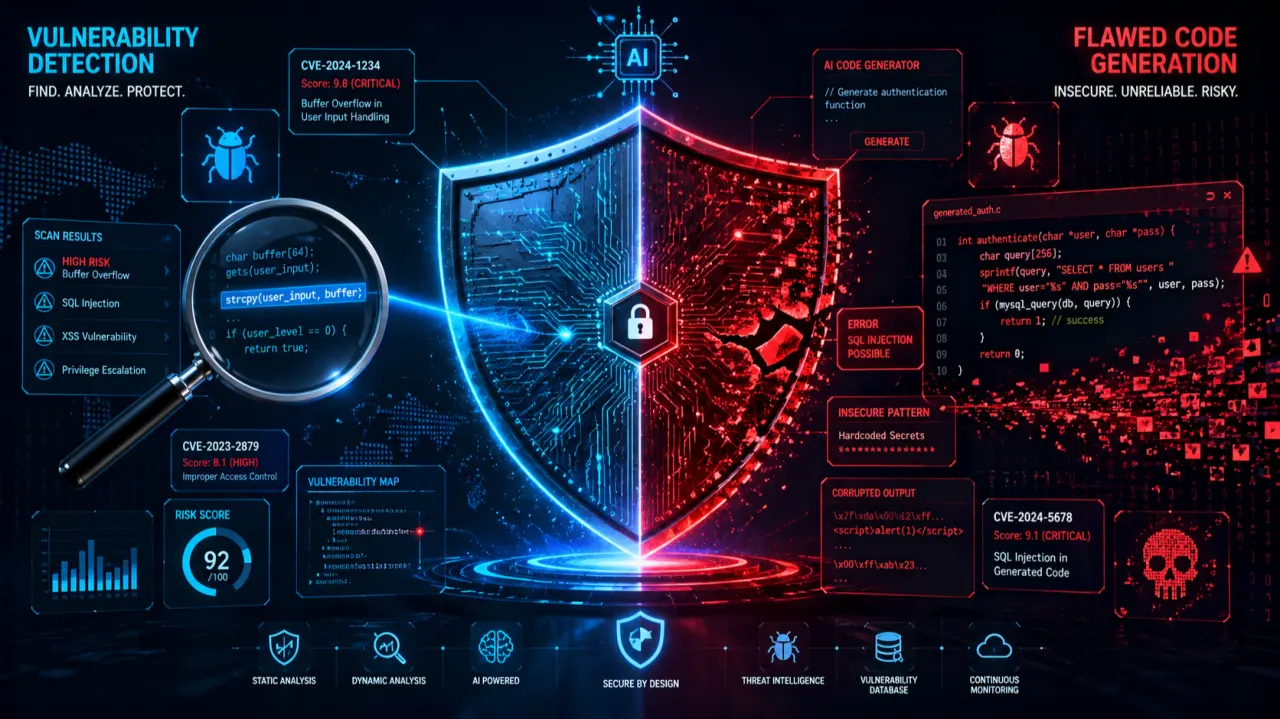
The quality data explains why trust is falling. AI-generated code produces approximately 1.7 times more issues than human-written code. 45% of AI-generated code samples fail security benchmarks across OWASP Top-10 categories. And then there is the finding from a Stanford randomised controlled trial that deserves its own paragraph: developers using AI tools wrote less secure code than those who didn't, while simultaneously reporting higher confidence in its security.
That last finding is the one that should make engineering leaders pause. It is not just that AI generates insecure code sometimes. It is that using AI tools appears to reduce the developer's own security awareness while making them feel more confident. The result is a combination that is arguably worse than being cautious and slow.
The experience gap makes the picture more complicated still. Only 3% of developers report high trust in AI output. Among experienced developers with 10+ years, just 2.6% highly trust AI-generated code - while 20% actively highly distrust it. The people with the most context for evaluating the output are the most sceptical of it.
Meanwhile, 40% of junior developers admit they deploy AI-generated code without full understanding of what it does. That is the vibe coding trust crisis in its clearest form: the people least equipped to catch problems are the ones most likely to ship without catching them.
The Security Problem Is Not Being Taken Seriously Enough
The security data in the vibe coding space deserves its own section because it is worse than most coverage acknowledges.
Every large language model has a training data cutoff. Security vulnerabilities, new attack patterns, and emerging exploit techniques that post-date that cutoff are invisible to the model. A vibe coder building an authentication system in 2026 with a tool trained on data from 2024 may be generating code that was considered secure in 2024 and is known to be vulnerable now.
The OWASP failure rate - 45% of AI-generated code samples failing security benchmarks - reflects a systematic problem rather than random errors. AI models tend to reproduce common patterns from training data. Common patterns are by definition the patterns attackers know and target. Asking AI to generate secure code is, in some respects, asking it to reproduce exactly the code patterns that security researchers have been documenting for years.
✦ Free Newsletter ✦
Never miss a story
Tools, tutorials and AI deep-dives - straight to your inbox, every week.
The vibe coding workflow compounds this. In a traditional development process, code review is where security issues are caught. In a pure vibe coding workflow where code is accepted without being read, there is no meaningful code review. The developer trusts that the AI generated something reasonable, runs it, and if it works proceeds to the next task.
This is not an argument against vibe coding. It is an argument for being clear-eyed about where the risks are concentrated and building the review and testing processes accordingly.
The Tools Driving the Market
The practical landscape of vibe coding tools in 2026 has consolidated around a few clear leaders, each with a distinct positioning.
Cursor is the most developer-focused option - an IDE built from the ground up for AI-assisted development. It sits closest to the assisted coding end of the spectrum, giving developers significant control while dramatically accelerating the process. The $2 billion valuation reflects both its adoption and the fact that developers who use it tend to keep using it.
Lovable sits at the opposite end - genuine vibe coding for product builders. You describe what you want to build, Lovable generates the full application, you iterate through natural language. The $400 million valuation and strong adoption among non-technical founders reflects how large the market is for people who want to build software without learning to code.
GitHub Copilot remains the most widely used tool by raw numbers, with 20 million users and integration into virtually every development environment. Microsoft's distribution advantage - Copilot is embedded in VS Code, GitHub, and Azure DevTools - means it reaches developers where they already are.
Claude Code and similar agentic tools represent the newer frontier - not just autocomplete or generation, but agents that can take a described task and implement it across an entire codebase, running tests, debugging failures, and iterating without constant human prompting. This is where the market is heading.
The token-based pricing shift at GitHub Copilot is worth noting because it reveals something about where the industry is going. Copilot recently moved from flat subscription pricing to consumption-based billing for agentic workloads - meaning developers who use it for complex multi-step tasks face significantly higher costs than those using it for simple autocomplete. The tools that do more are going to cost more, and the economics of vibe coding at scale are not yet fully understood.
Who Is Winning and Who Is Getting Left Behind
The productivity gains from vibe coding are not evenly distributed, and understanding the distribution matters for anyone making decisions about how to use these tools.
Senior developers are the biggest beneficiaries. They have the architectural judgment to decompose complex problems into well-specified prompts, the debugging instinct to catch problems in AI output quickly, and the domain knowledge to recognise when the code is subtly wrong in ways that will cause problems later. They are getting dramatically faster without sacrificing quality, because they have the skills to evaluate and correct what the AI produces.
Mid-level developers see significant gains but with meaningful overhead on review. They are fast at generation but slower at catching the edge cases and security issues that senior developers notice instinctively.
Junior developers are the most complicated story. The vibe coding workflow gives them access to code generation that would have been beyond their individual capability before. But without the underlying knowledge to evaluate what the AI produced, they are shipping things they do not fully understand. Whether this is a problem depends on what they are building and what the consequences of errors are.
The non-developer cohort - the 63% of vibe coding users who are not professional software engineers - is the wild card. They are building things that previously required hiring a developer or going without. The quality of what they build is highly variable. The things they are building often do not have the same quality and security requirements as enterprise production software, which makes the risk calculus different.
Where This Goes From Here
The trajectories are clear even if the endpoints are not.
Gartner projects that 40% of new enterprise production software will be built using vibe coding techniques by 2028, up from around 5% in 2024. Microsoft's CTO Kevin Scott predicted that 95% of all code will be AI-generated within five years. Whether those specific numbers prove correct, the direction is not in doubt.
The tools are getting better faster than the problems are being solved. Trust in AI code is falling at the same time adoption is rising, which suggests a reckoning is coming. At some point the gap between "this is fast" and "this is reliable" becomes visible in a way that changes how organisations think about what they are shipping.
The companies that are handling this well share a consistent approach. They are using vibe coding tools for the speed gains on routine and well-specified work. They are maintaining human review processes - specifically tuned for AI output, not the traditional code review process which was designed for human-written code and catches different classes of errors. They are being explicit about which parts of their codebase were AI-generated and treating those parts with appropriate scepticism in testing and security review.
The companies that are not handling this well are treating AI code generation as a replacement for engineering judgment rather than an amplifier of it. The short-term speed gains are real. The long-term cost of the debt being accumulated in codebases that nobody fully understands is being discovered gradually, project by project.
Vibe coding is not a fad and it is not the end of software engineering as a discipline. It is a tool shift of the same magnitude as the introduction of high-level programming languages, compilers, or version control - each of which changed what was possible, changed what skills mattered, and was initially met with both excessive enthusiasm and excessive scepticism.
The excessive enthusiasm is visible everywhere right now. The excessive scepticism is fading as the adoption numbers make the conversation moot. What remains is the harder work of figuring out which parts of software development benefit from AI acceleration, which parts require human judgment that AI cannot replace, and how to build organisations and workflows that take advantage of the former without losing the latter.
That work is ongoing. The tools will not wait for it to finish.

Advertisement