
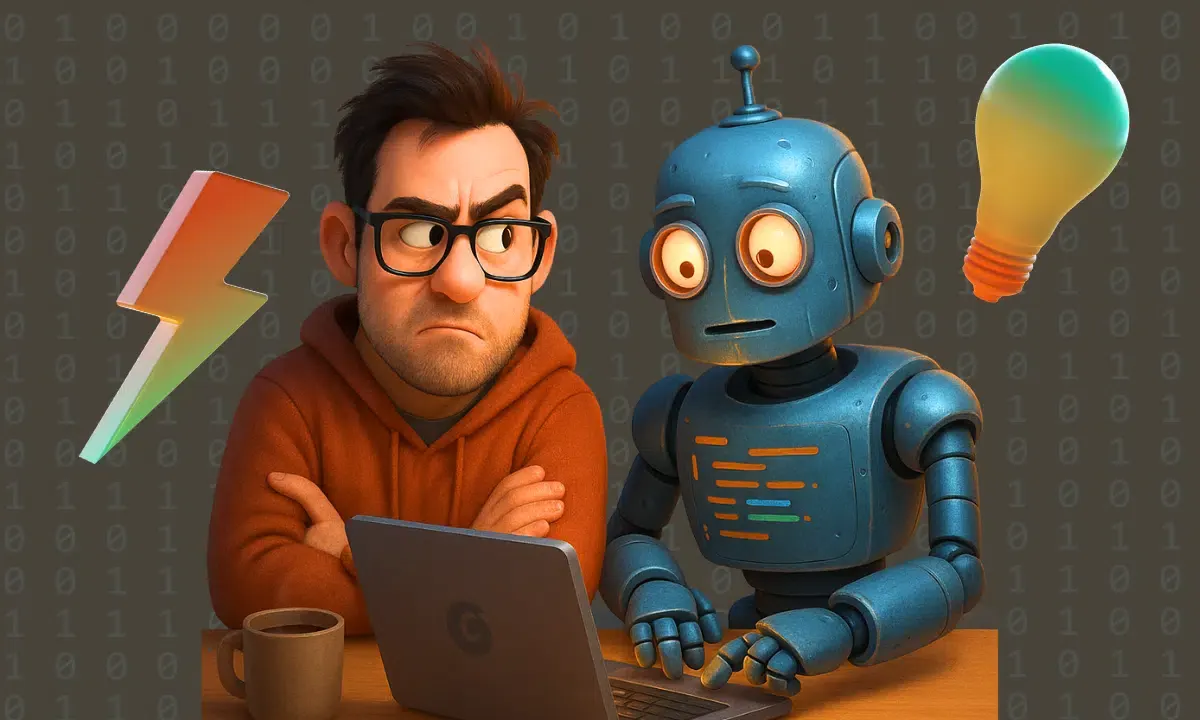
For about two decades, the software industry was quietly obsessed with a fantasy.
The 10x developer. The lone genius who ships what a team of ten can't. The person who lives in a hoodie, sleeps at weird hours, and produces code so elegant it makes other engineers feel inadequate. Every startup wanted one. Every hiring manager claimed to be looking for one. Every developer secretly wondered if they were one, or if they were one of the other nine.
That myth is dead. Not because the best developers got worse - but because AI handed the rest of us a significant portion of their superpowers, and it turns out the superpower was never really about raw intelligence. It was about speed, pattern recognition, and tolerance for tedious work. And those three things are exactly what AI tools do best.
Advertisement
We're not talking about the future here. We're talking about right now, June 2026, where the data from over 49,000 developers across 177 countries is unambiguous: 84% of developers are using AI coding tools. More than half use them every single day. The debate about whether to adopt these tools ended somewhere around 2025. The conversation has moved on to something more nuanced and more honest.
What does a good developer actually look like when the baseline has shifted this dramatically?
The Adoption Numbers Hide the Interesting Story
84% adoption sounds like a success story. And in one sense it is - tooling rarely achieves that kind of penetration this quickly. But the adoption numbers are only half the picture.
The other half is the trust gap, and it's striking. Only 3% of developers say they highly trust AI-generated code. Meanwhile 46% actively distrust its accuracy - they use the tools anyway, but with their hands hovering over the override button the entire time. That's not confidence in a new workflow. That's cautious dependency. The developer equivalent of using a sat nav while also knowing the route yourself, just in case.
This gap between usage and trust is where the real story lives. Developers have concluded that AI tools are too useful to ignore and too unreliable to fully believe. So they've developed something new: a working relationship with a fast, confident, frequently wrong collaborator. And managing that relationship well - knowing when to trust the output, when to gut-check it, and when to throw it away and write it yourself - turns out to be a skill in its own right.
The 10x developer used to be defined by output speed. The new version of that archetype is defined by judgment. How quickly can you evaluate what the AI gave you? How accurately can you spot the subtle bug in 40 lines of generated code that looks correct but isn't? How well can you decompose a complex problem into prompts that actually get you useful output rather than confident nonsense?
These are not the skills that boot camps have historically taught. They're also not the skills that "just learn to code" YouTube videos cover. But they're what separates effective developers in 2026 from ones who are either avoiding the tools out of principle or drowning in their output.
Language Rankings Are Flipping for the First Time in Years
Here's a more concrete signal that something structural has shifted: the programming language landscape, which has been remarkably stable for the better part of a decade, is moving.
Python continues to dominate and shows no sign of slowing. Its grip on data science, machine learning, automation, and increasingly web development has only tightened as AI use cases expanded the market for everything Python is good at. If you're a Python developer right now, the tailwind behind you is enormous.
JavaScript remains ubiquitous - it's the language of the web and that isn't changing. But its dominance at the top of "most used" surveys is being pressured from an unexpected direction.
Rust is going mainstream. Not "going mainstream" in the way that gets said every year about Rust and never quite happens - actually, measurably, consequentially mainstream. Systems programming work that would have defaulted to C++ three years ago is increasingly being written in Rust. The Linux kernel has Rust. The Windows kernel has experimental Rust. Mozilla, Amazon, Google, and Microsoft are all either shipping Rust in production or actively migrating critical components toward it.
Advertisement
Why does this matter for the average developer? Because Rust's rise is a response to a specific, expensive problem: memory safety vulnerabilities. A significant portion of critical security bugs in C and C++ codebases trace back to memory management errors - the kind of errors Rust's ownership model makes structurally impossible. Governments and large enterprises are starting to mandate memory-safe languages for new infrastructure work, and Rust is the primary beneficiary.
If you're currently working primarily in C or C++ on systems-level code, Rust is no longer something you can defer learning indefinitely. It's showing up in job requirements, in new projects, and increasingly in the maintenance of existing systems. The window for treating it as optional is closing.
GitHub Just Made Its Biggest Platform Move in Years
GitHub's recent changes deserve their own section because they represent a shift in what the platform actually is - not just a code hosting service with some added features, but something closer to an AI-native development environment.
✦ Free Newsletter ✦
Never miss a story
Tools, tutorials and AI deep-dives - straight to your inbox, every week.
GitHub Copilot has been steadily eating more of the development workflow. What started as autocomplete has expanded into code review, pull request summaries, vulnerability detection, and now agentic coding - where Copilot doesn't just suggest the next line but can take a described task and implement it across multiple files with minimal handholding.
The more significant move is GitHub's push toward Copilot Workspace, which attempts to take a developer from issue to pull request with AI handling much of the implementation. The vision is explicit: you describe what needs to change, the AI figures out which files to touch and how, you review and approve or modify, and the PR gets submitted.
Whether this workflow actually holds up in production codebases - the messy, decade-old, underdocumented kind that most working developers actually live in - is a different question from whether the demo is impressive. In controlled settings with clean codebases it works well. In the real world the jury is still out, and experienced developers are appropriately cautious.
But the direction is clear. GitHub is betting that the future of software development runs through an AI layer that sits between the developer's intent and the actual code. Whether that's liberating or alarming probably depends on how secure you feel about the judgment-and-evaluation skills discussed above.
The Trust Crisis Nobody Is Talking About Loudly Enough
Let's come back to that trust gap, because I think it's being significantly underplayed in most coverage of AI coding tools.
The standard narrative is adoption curve triumphalism - look how fast this happened, look how many developers are using these tools, the future is here. What gets less attention is what it means for the industry that nearly half of developers are using tools they don't trust.
In any other professional context this would be alarming. Imagine 46% of surgeons reporting they actively distrust the accuracy of a piece of diagnostic equipment they use every day anyway. Or 46% of accountants distrusting the output of the software they use for tax calculations while continuing to file with it. We'd call that a systemic risk problem.
In software development it gets framed as a learning curve. And there's something to that framing - the tools are genuinely getting better quickly, and developers are getting better at using them. The distrust is partly rational caution and partly unfamiliarity with a new collaborator's failure modes.
Advertisement
But it's worth sitting with the honest version of what's happening: we've introduced a widely-adopted tool into a profession where the output of that tool has downstream consequences - in security, in reliability, in systems that real people depend on - and we've done so faster than the industry's quality assurance practices have adapted. Code review processes weren't designed for reviewing AI output at scale. Testing cultures weren't built around catching the specific failure patterns that AI-generated code tends to produce.
This isn't a reason to stop using the tools. It's a reason to be clearer-eyed about where the risks actually are.
What the New "10x Developer" Actually Looks Like
So if the myth is dead, what replaced it?
The developers who are pulling ahead right now share a few characteristics that don't fit the old archetype cleanly.
- Fast at evaluation, not just generation. They can look at 50 lines of AI output and identify the problem in 30 seconds, or confirm it's clean and move on. This is a different skill from writing good code from scratch - it's closer to code review as a superpower.
- Good at problem decomposition. Breaking a complex feature into a series of well-specified sub-problems that AI can handle reliably is genuinely hard. The developers who do this well get dramatically more usable output than those who try to prompt their way to a complete solution in one shot.
- Deep knowledge in at least one area. Ironically, as AI handles more of the routine implementation work, having genuine depth in a specific domain has become more valuable rather than less. Security, distributed systems, performance engineering, ML infrastructure - these areas require judgment that current AI tools can't reliably provide. The developer who has that depth and also wields AI tools effectively is formidably capable.
- Comfortable with ambiguity about authorship. A lot of developers have identity tied up in the code they write. When AI writes a significant portion of that code, something shifts. The developers who adapt well tend to have shifted their identity toward outcomes - what shipped, what worked, what the user experienced - rather than the craft of the code itself.

None of this sounds like the lone genius in the hoodie. It sounds more like a skilled editor who also happens to be a strong writer, working alongside a very fast, occasionally unreliable ghostwriter.
That's a less romantic image than the 10x developer myth. But it's closer to what good software development actually looks like in 2026. And honestly, it's a more interesting and more learnable skill set than raw genius ever was.
The industry spent years fetishising a type of developer that was always rarer than the mythology suggested. What's replacing that myth might actually be more democratic - not in the sense that everyone becomes equally capable, but in the sense that the ceiling is higher for more people, and the path to becoming genuinely effective is clearer than it used to be.
Advertisement
That's not nothing. That might actually be progress.
Frequently Asked Questions
- Is the 10x developer myth really dead in the age of AI?
- The myth in its original form - the lone genius whose output dwarfs a whole team - has been undermined by AI tools that give average developers access to speed and pattern-matching that used to be rare. But a new kind of high-performance developer is emerging: one defined by judgment, evaluation speed, and the ability to decompose problems effectively rather than raw coding ability.
- Why do most developers distrust AI-generated code even though they use it daily?
- According to surveys of over 49,000 developers, only 3% highly trust AI-generated code while 46% actively distrust its accuracy. The tools are fast and useful for routine work, but they produce confident-sounding errors that are hard to catch without domain knowledge - so most developers treat the output as a starting point that needs review rather than finished work.
- Should I learn Rust in 2026?
- If you work in systems programming - especially C or C++ - yes, and probably sooner than you'd like. Rust is now in the Linux and Windows kernels, mandated for new infrastructure work by several governments and large enterprises, and showing up in job requirements at a rate that makes it hard to ignore. For web or application developers the case is less urgent, but the direction of travel is clear.
Advertisement