

Here's a question nobody in tech wants to answer honestly: if AI is doing the work that junior developers used to do, where exactly do the senior developers of 2030 come from?
Because that's the thing about destroying the entry level of a profession. The consequences don't show up immediately. They show up five years later, when the people who would have become your most experienced engineers never got the chance to learn. When the pipeline is empty and the companies that gutted it are wondering why they can't find good talent anywhere.
We're planting that problem right now. And the industry is too busy celebrating AI productivity gains to notice.
Advertisement
What Is Actually Happening to Junior Developer Jobs
Let's be precise about this, because the discourse tends to swing between "AI is taking all the jobs" panic and "developers will always be needed" dismissiveness. The reality is more specific and more uncomfortable than either.
Junior developer positions are being eliminated. Not gradually. Not as a long-term trend to monitor. Right now, actively, in large numbers. The bootcamp graduate who could reliably land a junior role in 2022 or 2023 is now competing in a market where the companies that would have hired them have either frozen entry-level headcount entirely or concluded that AI tools in the hands of a smaller senior team can cover the same output.
The numbers are stark. Developers are applying for 200 to 300 positions to get a single callback. Tech job openings at the entry level are down sharply - not because demand for software has fallen, but because the labour required to produce it has compressed. Companies that ran teams of ten are running teams of four, with AI tools filling the gap. Why hire someone to write boilerplate, scaffold projects, and handle routine bug fixes when GitHub Copilot does it in seconds?
The logic is financially coherent. That's what makes it so hard to argue against in a boardroom. The quarterly cost savings are real and immediate. The consequences are deferred and diffuse. Companies making this decision won't feel the damage they're doing. Not yet.
The Talent Pipeline Nobody Is Thinking About
Here's what gets missed in most coverage of this issue: junior developers don't just produce output. They become people.
Every senior engineer with fifteen years of experience and deep system intuition was once a junior developer writing bad code, getting it reviewed, rewriting it, learning why their architectural choices created problems six months down the line, and slowly building the judgment that no amount of AI assistance can substitute for. The entire value of an experienced engineer - the ability to make good decisions under uncertainty, to understand why a system is behaving unexpectedly, to anticipate failure modes before they become incidents - comes from years of doing the messy, unglamorous work that junior roles are built around.
When you eliminate that learning ground, you don't just lose the junior output. You destroy the mechanism that produces senior engineers.
The industry has not reckoned with this. The companies cutting junior headcount are, in effect, strip-mining their own future talent supply. They're benefiting from a stock of experienced engineers that took fifteen years to develop, while simultaneously ensuring that no equivalent stock is being replenished.
This isn't speculation. It's already showing up in hiring. Senior developers with strong system design skills, deep debugging ability, and genuine architectural judgment are increasingly rare and increasingly expensive. Companies are competing for a fixed pool rather than growing a new one. The premium on experience is rising precisely because the pipeline feeding it is being cut off at the source.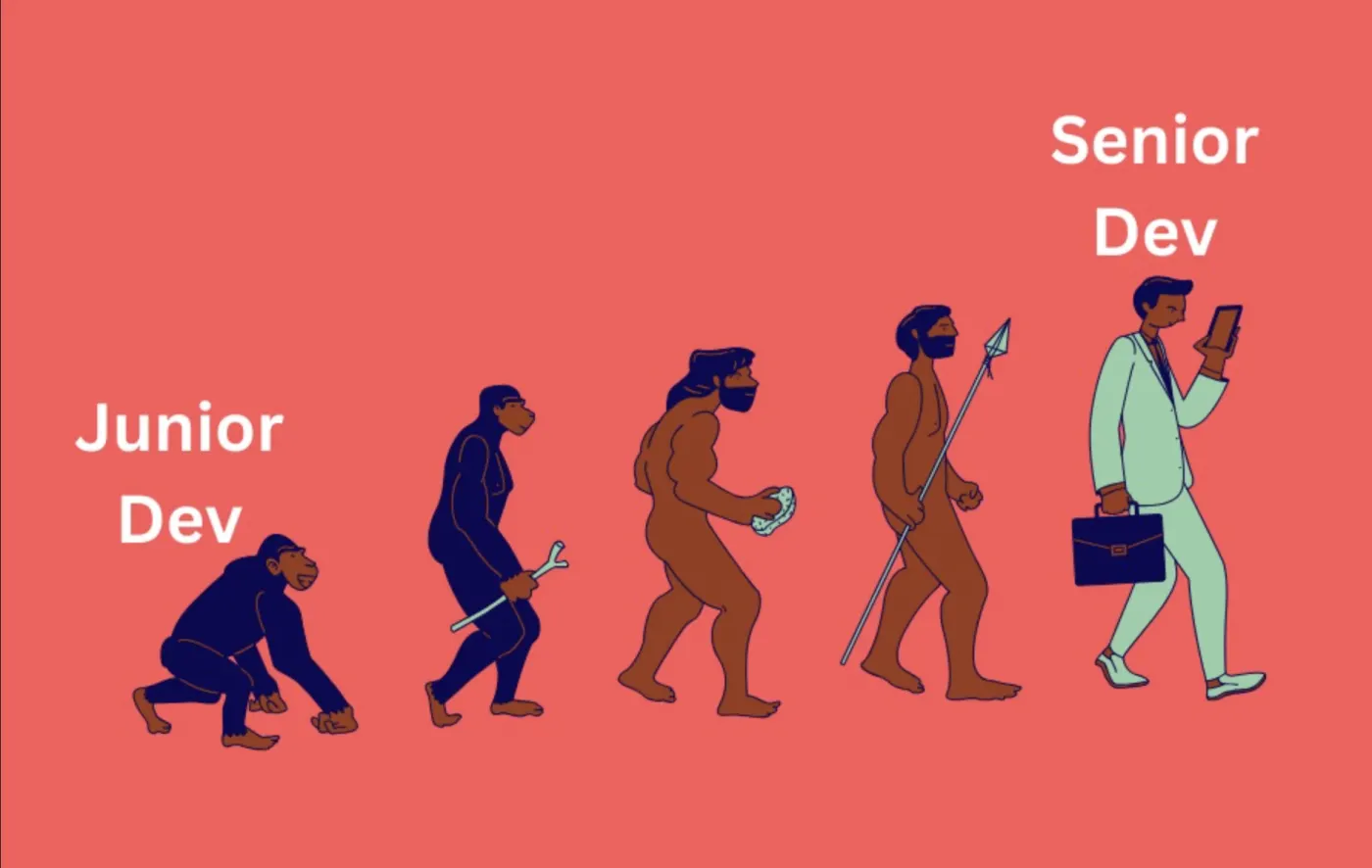
The Specific Skills That Only Come From Doing Junior Work
It's worth being concrete about what junior-level experience actually builds, because "they learn on the job" undersells how specific and irreplaceable the knowledge is.
Debugging real systems under pressure. The first time you spend three days tracking down a production bug that turns out to be a race condition in code you didn't write, in a system you don't fully understand, with your senior engineer explaining the tracing tools while your manager asks for updates every four hours - that experience deposits something in your technical intuition that a textbook cannot. You learn what systems feel like when they're failing. You develop pattern recognition for certain classes of problems. You understand that elegant code and reliable code are not always the same thing.
Advertisement
AI tools are genuinely bad at this specific task. They can generate plausible-looking code fast. They are much weaker at reasoning about why a running system is misbehaving in ways that the code doesn't obviously predict. That skill is developed through repeated exposure to real failures in real systems. Junior roles provide that exposure. Eliminating junior roles means fewer people get it.
Navigating existing codebases. The romantic image of software development is writing new things from scratch. The reality of most professional software work is reading, understanding, and modifying code that other people wrote, often years ago, with varying levels of documentation and consistency. Learning to move through a large, messy, partially-understood codebase is a skill. It takes time to develop. It cannot be simulated.
Understanding consequences at scale. A junior developer who pushes a change that causes an incident, participates in the post-mortem, and helps fix the underlying problem has learned something invaluable: that software decisions have real consequences for real people, and that the gap between "it works on my machine" and "it works in production at scale" can be enormous. This lesson shapes every technical decision they make for the rest of their career.
Learning how teams actually work. Code review, standups, technical disagreements, navigating competing priorities between product and engineering, understanding why certain decisions get made for non-technical reasons - these are learnable only through participation. An AI tool can write code. It cannot teach someone how to operate effectively inside a human team making imperfect decisions under time pressure.
✦ Free Newsletter ✦
Never miss a story
Tools, tutorials and AI deep-dives - straight to your inbox, every week.
The Defence You'll Hear - And Why It Isn't Good Enough
The standard response to this argument goes something like: the nature of junior work will change. Juniors will move up the value chain. Instead of writing boilerplate, they'll supervise AI agents. Instead of fixing routine bugs, they'll review AI-generated code. The role evolves, it doesn't disappear.
There's something to this. The developer role is genuinely changing, and the most adaptable people are finding new footholds in the new landscape. But this argument has a serious problem: it assumes the transition happens smoothly and that the new "junior" role - AI supervisor, agent reviewer, prompt engineer - provides the same kind of learning depth as the old one.
It doesn't. Not yet, and possibly not ever.
Reviewing AI-generated code tells you whether the output is correct. It does not give you the same depth of understanding as having written it yourself, having had it reviewed, having had the reviewer explain why your approach created a memory leak, and having refactored it three times. Supervising an agent that scaffolds a project is not the same as having built the scaffolding by hand and understood why every decision was made.
The new junior role, to the extent it's emerging, is producing a different and potentially thinner kind of learning. Whether that's sufficient to develop the same calibre of senior engineers over time is genuinely unknown. Nobody has run this experiment to completion. The companies making these hiring decisions are betting that it works out. They are betting with other people's careers and with the long-term health of the industry.
What This Means If You're Early Career Right Now
The honest answer is that this is a genuinely bad time to be entering the software development job market, and anyone telling you otherwise is probably trying to sell you a course.
That said - bad is not hopeless, and the picture is more differentiated than the headline numbers suggest.
Entry-level positions have not disappeared uniformly. They've concentrated. Financial technology companies building AI-driven trading infrastructure are hiring engineers who can solve actual hard problems. Manufacturing automation is expanding. Data infrastructure work is growing. The sectors where software creates direct, measurable, high-value output are still hiring because the work requires genuine human judgment and cannot be compressed away with AI tools.
Advertisement
The pattern across all of these sectors is the same: complexity and ownership. The junior roles that are surviving and growing are the ones where the work is too complex, too context-dependent, or too consequential to delegate to AI without close human oversight. The ones that are disappearing are the routine, well-defined, easily specifiable tasks that AI handles well.
This means the entry point to the profession has shifted. The bar is higher. Generic skills are worth less than they were. Specialised, problem-solving, domain-aware skills are worth more. The path from learning to code to having a job is harder and longer than it was three years ago. That's true. It doesn't mean the path is gone.
It means the shortcuts are gone. The developer who got hired on the strength of knowing React and being able to build a CRUD application is competing with AI now and losing. The developer who understands distributed systems, who has domain expertise in a specific industry, who can take an ambiguous problem and produce a well-reasoned technical approach - that developer is not only surviving but doing well.
The Conversation the Industry Needs to Have
The thing that frustrates me about how this topic gets covered is that it's almost always framed as a binary. Either AI is replacing developers (panic) or developers will always be needed (reassurance). Both framings avoid the harder question, which is: what does the industry owe to the people whose entry pathway has been disrupted, and what does it owe to its own future health?
The companies benefiting most from AI productivity gains - the ones that compressed their teams from ten to four and kept the output - are not currently contributing to solving the pipeline problem they're creating. They're extracting value from the existing stock of experienced talent while making that stock harder to replenish.
This is not sustainable. The senior engineers of 2035 have to come from somewhere. If the industry spends the next five years eliminating the conditions that produce them, it will spend the five years after that wondering why good engineering talent is so scarce and so expensive.
The developers paying the immediate price for this are the ones who learned to code with the expectation of a career that the market has quietly moved. That's a real harm to real people and it deserves acknowledgment rather than "the market will adapt" dismissal.
The market will adapt. It always does. The question is who bears the cost of the adaptation period, and whether the industry is being honest about the choices it's making.
Advertisement
Right now the cost is being borne by early-career developers who did everything right and arrived at exactly the wrong moment. That's worth saying clearly, even if the industry would rather focus on productivity charts.
Frequently Asked Questions
- Are junior developer jobs really disappearing, or is this overstated?
- The data is difficult to ignore. Entry-level job postings are down sharply, and developers report sending 200 to 300 applications for a single callback. The mechanism is specific: companies are running smaller senior teams augmented by AI tools rather than hiring juniors to handle routine work. The jobs haven't all disappeared, but the market has compressed significantly and entry-level roles have concentrated in sectors where work is too complex for AI to handle unsupervised.
- What skills should junior developers focus on to stay employable in 2026?
- The roles surviving and growing share two traits: complexity and ownership. Generic skills — building CRUD apps, writing boilerplate, basic React — are now easily replicated by AI. What's harder to replicate is domain expertise in a specific industry, the ability to reason about distributed systems or security, debugging judgment in real production environments, and the skill to take an ambiguous problem and produce a coherent technical approach. Depth in one area beats breadth across many.
- Why does eliminating junior developers hurt the long-term health of the industry?
- Senior engineers don't arrive fully formed — they develop through years of junior work: debugging real production systems, navigating existing codebases, understanding consequences at scale, and learning how engineering teams actually function. Eliminating junior roles removes the learning ground that produces experienced engineers. Companies are currently benefiting from a stock of senior talent built up over fifteen years while simultaneously cutting off the pipeline that replenishes it. The consequences will show up in five to ten years as a serious shortage of experienced engineers.
Advertisement